- Ginazhao@wanglumaterial.com
- Mon - Sat at 7:00AM to 9:00PM
Inquiry
Form loading...
-
E-mail
-
E-mail

Global buyers are paying closer attention to renewable interior materials, but sustainability claims need evidence. Bamboo Charcoal Wood Veneer sits within this changing market. It combines a natural bamboo surface with charcoal-based visual texture, offering dark grain, warm tactility, and a distinctive alternative to conventional wood veneers. It can suit wall panels, furniture fronts, hospitality interiors, and custom cabinetry.
Scale matters. The International Bamboo and Rattan Organisation reports that bamboo covers approximately 35 million hectares worldwide, supporting wider interest in engineered bamboo products. The FAO Global Forest Resources Assessment 2020 also identifies responsible material sourcing as a central issue for forest-product industries. These reports do not certify every veneer product. They provide useful context, not automatic proof.
Reliable purchasing requires more than attractive photographs. Buyers should request bamboo species, charcoal treatment details, veneer thickness, core composition, adhesive information, moisture resistance, and formaldehyde test results. Ask for batch samples. Inspect the surface under side lighting. Small pores, uneven darkening, or weak edge bonding may appear after machining. That matters.
Certification can strengthen confidence. Depending on the market, buyers may review FSC chain-of-custody documentation, ISO-based quality systems, and laboratory reports aligned with relevant indoor-air standards. Requirements differ across the European Union, North America, and Asia-Pacific. Local verification remains essential.
The market is promising, but it is not flawless. Some suppliers overstate carbon benefits without showing life-cycle boundaries or transport impacts. Charcoal coloring can also vary between batches. A careful specification should therefore balance appearance, durability, safety, and traceability. This 2026 guide helps global buyers compare Bamboo Charcoal Wood Veneer with clearer expectations, practical testing, and evidence-based judgment.
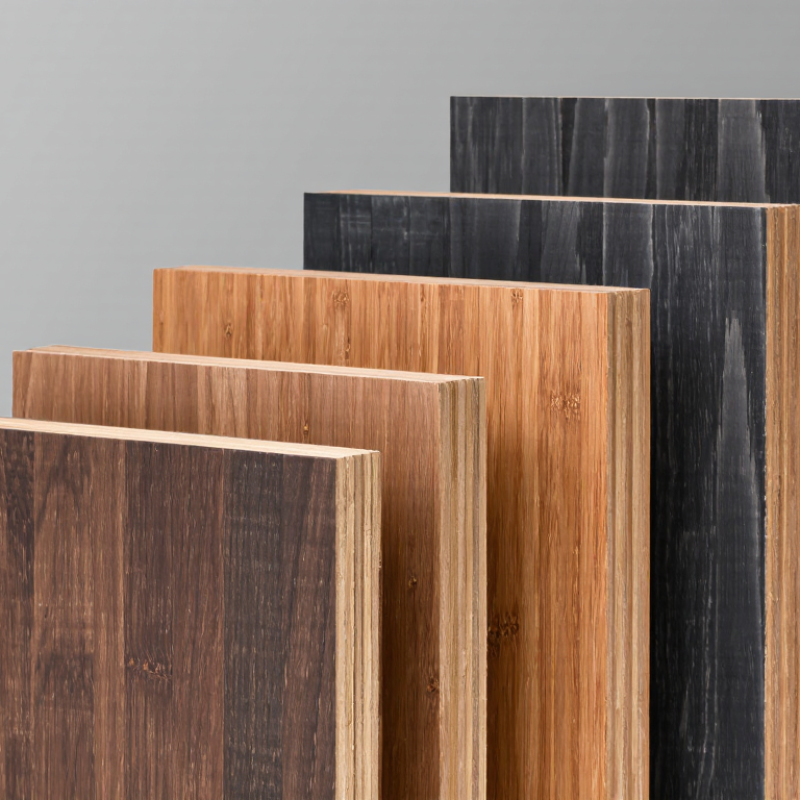
Bamboo charcoal wood veneer is a thin decorative surface made with carbonized bamboo particles, fibers, or sheets. It is usually bonded to plywood, MDF, or another stable wood panel. The charcoal content gives the veneer a deep gray-to-black appearance, often with fine pores and a warm, matte texture. It is not solid charcoal wood. That distinction matters during specification and testing.
The FAO Global Forest Resources Assessment 2020 estimated global bamboo coverage at about 35 million hectares, although regional counting methods differ. This expanding resource supports interest in bamboo-based interior materials. However, bamboo charcoal does not automatically guarantee odor removal, humidity control, or healthier indoor air. Those claims require laboratory evidence. Buyers should request thickness tolerance, bonding strength, surface wear results, and emissions testing. ISO 22157:2019 provides recognized methods for evaluating bamboo’s physical and mechanical properties, but it does not certify every finished veneer product. The label can mislead.
Tips: Ask for the charcoal percentage, substrate type, adhesive information, and test reports. Inspect a sample under side lighting. Uneven pores, brittle edges, or strong chemical odor may indicate poor processing. For public interiors, check local VOC and fire requirements before ordering. I would also compare samples after heat and humidity exposure; a beautiful panel can still warp.
| Data Dimension | Typical Commercial Information | Why It Matters to Global Buyers |
|---|---|---|
| Product definition | A decorative veneer or thin facing made from bamboo-based material that has been carbonized, usually bonded to a stable substrate such as plywood, MDF, particleboard, or a composite panel. | The term can describe either a thin decorative face layer or a finished panel. Confirm the construction before comparing quotations. |
| Typical face-layer thickness | Approximately 0.3–1.0 mm for flexible decorative veneer faces; thicker bamboo-charcoal decorative sheets are also available depending on the manufacturing process. | Thickness affects trimming, edge treatment, flexibility, repairability, and the visible depth of the surface texture. |
| Finished panel thickness | Common engineered-panel thicknesses include approximately 3–18 mm, with the substrate determining most of the final thickness. | Select thickness according to cabinet doors, wall panels, furniture components, or interior partitions. |
| Surface appearance | Usually ranges from warm brown and dark brown to charcoal black, with straight, strand-woven, smoked, brushed, or textured patterns. | Color and grain consistency should be checked by approved samples because carbonization intensity changes the final appearance. |
| Bamboo source | Commonly produced from mature bamboo culms that are sliced, laminated, strand-formed, or reconstituted before or after carbonization. | Source maturity and processing method influence grain pattern, strength, dimensional stability, and color uniformity. |
| Carbonization process | Controlled heating in a low-oxygen environment converts part of the bamboo’s organic components into a carbon-rich material. Higher treatment temperatures generally produce darker colors and greater mass loss. | Ask for the carbonization method, treatment temperature range, and process consistency when color and performance are critical. |
| Bamboo charcoal bulk density | Common bamboo-charcoal materials are often reported in an approximate bulk-density range of 0.3–0.7 g/cm³, depending on raw material, furnace conditions, and particle or block structure. | Density is not the same as panel density. Request a product-specific test report if weight, stiffness, or acoustic performance is important. |
| Moisture content | A practical target for interior bamboo veneer and engineered panels is commonly about 6–12%, subject to the substrate, climate, adhesive system, and applicable standard. | Moisture should be compatible with the installation environment to reduce swelling, shrinkage, cracking, or delamination. |
| Dimensional stability | Generally better when the veneer is cross-laminated or bonded to a balanced substrate. Unbalanced construction can increase the risk of warping. | Specify face-and-backing construction, panel balancing, conditioning requirements, and allowable warpage in the purchase specification. |
| Adhesive system | Typical systems may include urea-formaldehyde, melamine-urea-formaldehyde, phenolic, polyurethane, or other engineered adhesives, depending on the substrate and end use. | Adhesive selection affects bonding strength, moisture resistance, formaldehyde emissions, recyclability, and compliance requirements. |
| Formaldehyde emissions | Emissions are determined mainly by the adhesive and substrate, not by the bamboo-charcoal appearance alone. Results should be verified using the destination market’s required test method. | Request a current laboratory report and specify the required class or limit, such as the applicable EN, ASTM, CARB, or other regional requirement. |
| Surface finish | Available finishes commonly include unfinished, oil-finished, water-based coated, UV-coated, matte, satin, or textured surfaces. | Finish selection changes stain resistance, gloss, cleanability, color stability, repair options, and installation requirements. |
| Typical applications | Interior wall cladding, cabinet fronts, furniture panels, doors, ceilings, decorative screens, retail displays, and hospitality interiors. | Most products are intended for interior decorative use unless the complete panel system has been tested for exterior or high-humidity conditions. |
| Indoor and outdoor suitability | Standard decorative bamboo-charcoal veneer is generally better suited to dry interior environments. Outdoor use requires a separately tested panel, finish, adhesive, and edge-sealing system. | Do not infer exterior durability from the word “charcoal.” Request weathering, water-resistance, and dimensional-stability evidence. |
| Fire performance | Fire classification depends on the complete assembly, including veneer, adhesive, substrate, coating, thickness, and installation method. | For commercial projects, specify the required local fire-test standard before production and obtain a report for the actual panel construction. |
| Acoustic and adsorption claims | Bamboo charcoal is porous, but a sealed veneer or coated panel should not automatically be described as an air-purifying, odor-removing, or sound-absorbing product. | Only use performance claims supported by tests on the finished product under defined conditions. |
| Key documents for importing | Technical data sheet, composition statement, dimensions and tolerances, moisture report, adhesive information, emissions report, fire report where required, packing list, and certificate of origin. | A complete document package reduces customs, project-approval, installation, and quality-inspection risks. |
Buyer note: The figures above are typical commercial ranges rather than universal specifications. Actual performance depends on the bamboo species, carbonization process, veneer construction, substrate, adhesive, coating, test method, and installation environment.